Slip Fielders or a Sweeper: Two Ways to Cover Risk
Slip fielders or a sweeper reveal how captains weigh edges against boundary shots, helping you read the bowling plan and the batter’s likely scoring options.
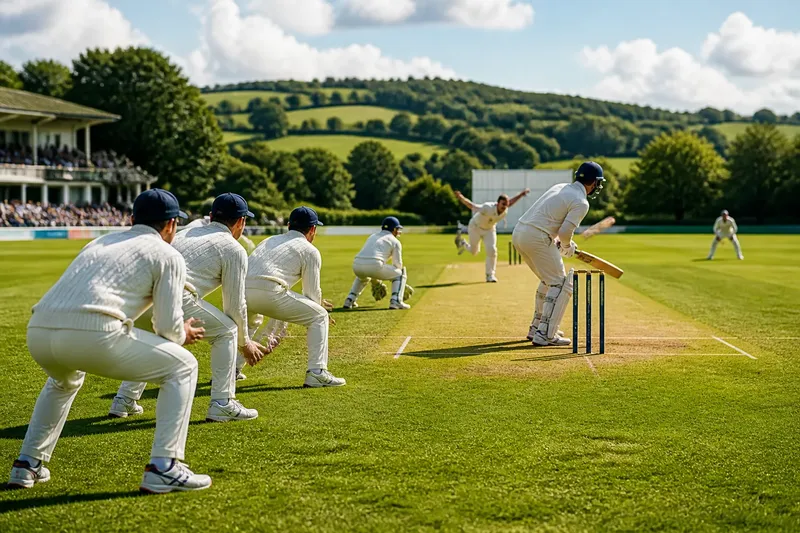
Slip fielders or a sweeper tell you what a captain fears the batter will do next. A slip stands close behind the bat to catch an edge; a sweeper waits near the boundary to stop a shot from reaching it. Both positions cover risk, but they protect against very different outcomes.
Watch where the captain places these fielders, then look at the bowler’s line and the batter’s response. The field is not a prediction that one result will happen. It is a choice about which danger is worth guarding against, and which opening the captain is prepared to leave.
What does a slip fielder protect against?
A slip stands behind the batter, usually on the off side, angled to catch a ball that takes the edge of the bat. The wicketkeeper is directly behind the stumps; slips form a catching cordon farther to the side. A ball travelling quickly off an edge may be difficult for the keeper to reach, but fall within a slip’s path.
Slips are most useful when the bowler is making the batter play at a ball that could move away, or when bounce and pace make an edge plausible. A delivery outside off stump may tempt a drive or a defensive push. If the bat meets it at an awkward angle, the ball can fly towards the cordon rather than along the ground.
That possibility shapes the whole contest. A slip fielder can support a plan to attack the stumps or draw a mistake outside them, but the position only pays off if the bowler repeatedly creates chances in that area. If the batter is leaving comfortably or the ball is too far away to reach, a slip may have little to do.
What does a deep sweeper prevent?
A sweeper, often called a deep cover or deep point depending on the exact position, patrols the boundary on the off side. The role is to intercept a shot that has been struck into that region and limit the result. A well-placed sweeper can turn a likely boundary into a catchable stop or a return from the field.
Captains often use one when a batter is driving, cutting or lofting the ball into the off-side gap. The fielder may stand close to the rope or farther in, depending on whether the greater concern is a clean boundary or a shot landing short of the edge. The position also affects the batter’s options: a gap can invite a shot, while a boundary fielder makes the same shot less rewarding.
A sweeper does not stop the batter from scoring. A shot may still pass beyond reach, or the batter may take a single into the space in front of the fielder. The captain is accepting those possibilities in return for protection against a bigger scoring result.
How do the two positions express different bets?
A slip is a bet on a chance to dismiss. It leaves part of the field open so the bowler can tempt an edge, and the fielder is there to turn that mistake into a catch. A sweeper is chiefly a bet on limiting damage: the captain expects the ball might be struck into a scoring area and assigns someone to stop the biggest outcome.
Those aims are not opposites. A captain can keep slips and a sweeper at the same time, covering both the edge and a powerful drive. But fielders are limited, so adding one position can leave another area exposed. The important question is not simply whether a field looks attacking or defensive; it is what the captain has chosen to protect first.
Imagine a right-handed batter repeatedly reaching for balls outside off stump and driving them hard through cover. The captain might move a fielder from the inner ring to deep cover, expecting the batter to keep choosing that shot and wanting to cut off the boundary. If the bowler then gets the batter to edge a fuller ball, a slip would have offered a catching chance—but that area may now be unguarded. The change is a visible trade-off, not proof that either outcome was certain.
What should you watch alongside the field?
A fielder’s position makes more sense when you connect it to the delivery. Notice whether the bowler is pitching the ball up, aiming at the stumps, or sending it wider. Then see whether the batter is defending, leaving, driving or trying to force the ball across the field.
Also watch the field change after a boundary or a near-miss. A captain may bring a sweeper in when the batter is nudging singles, or move a slip into the ring if the bowler is no longer finding a threatening line. Changes can respond to the over’s immediate pattern, the batter’s strengths, the match situation and the bowling plan.
Do not assume that a fielder’s depth has one fixed meaning. A deep fielder can be positioned for a catch as well as a stop, especially if the batter is likely to loft the ball. Equally, a slip is not automatically an attacking signal if the bowler is struggling to control the line. The delivery and the batter’s choices help explain whether the position is doing its intended job.
Which fielding choice matters more in different situations?
There is no universal winner. A captain may favour slips when the ball is offering movement and the batter has to play at uncertain deliveries. A sweeper becomes more valuable when the batter can reliably reach the boundary through a particular gap. Conditions, score, batter, bowler and format all shape the judgement.
In a longer innings, a captain may accept that the batter can score singles while keeping catching positions for a sustained attack. In a short, high-scoring phase, preventing boundaries may take priority. These are broad tendencies, not rigid rules: a team can still attack with a sweeper in place, or defend runs while retaining slips if a wicket is especially valuable.
The most revealing moment is often the space the captain leaves open. If deep cover is occupied but the slip cordon is thin, the plan may be willing to concede a chance of a single or an edge in exchange for boundary protection. If slips are packed and the deep boundary is clear, the captain may be inviting the batter to take a risk against the catching field.
What questions help you read these positions?
Why are slips placed behind the batter?
They cover edges that fly past the wicketkeeper, particularly when a delivery makes the batter play outside the line of the stumps. Their value depends on the bowler creating a realistic chance of contact at the edge.
Is a sweeper always on the boundary?
The name commonly refers to a deep fielder protecting an off-side boundary, but the exact position can vary. Check whether the fielder is near the rope or stationed inside it, since that changes whether they are mainly cutting off a boundary or covering a broader scoring area.
Can a captain use slips and a sweeper together?
Yes. The captain can protect against an edge and a powerful off-side shot at once, but those positions use fielders who could otherwise guard different areas. Read the rest of the field to see which gaps remain open.
Does a sweeper mean the bowler is defensive?
Not necessarily. The bowler may still be trying to take a wicket while the sweeper limits the result of a drive or lofted shot. Judge the plan by the line, length and other fielders rather than one position alone.
What is not worth over-reading?
One delivery rarely explains a whole field. A captain may have moved a fielder for a particular batter or a temporary bowling plan, and the next ball may call for a different arrangement. It is not worth treating every boundary fielder as a sign that the bowler has stopped attacking.
Instead, look for a pattern: which shots are being offered, which are being discouraged, and whether the field shifts after the batter finds a gap. Slip fielders or a sweeper become easier to understand when you read them as two answers to the same question: is the greater risk a chance to dismiss the batter, or a shot that runs away for four?